By Jacques Denis
Miles, A History in Blue
"The very first thing I remember from my early childhood is a flame, a blue flame leaping from a stove". That's how Miles opens his autobiography. In it, one can read what defines a part of his music: A Kind Of Blue, to paraphrase the trumpeter's best-seller. Blue notes are the story of his life, even though he recorded fairly little under his own name for the storied label, given the scope of his career. That was at the beginning, when the young man with the trumpet was mostly signed to Prestige, like Blue Period, three tracks (including Out of the Blue, of course), but quite the lineup (Art Blakey, Percy Heath, Sonny Rollins...). Soon he would cut Blue Haze, and then Blue In Green.
Where there's blue, there's also blues. "A music always present in Miles," John McLaughlin once said. On that count, the man who would be crowned the Prince of Darkness was more than prolific: Blues by Five, Blues For Pablo, Blues in F, Celestial Blues, Basin Street Blues... Not to mention The Meaning of the Blues, of which he delivered a masterly version in 1957 on Miles Ahead, midnight-blue swirls sublimated by Gil Evans. So what exactly is it? "The blues isn't a name, it isn't a word, it's not a label, it's just a sound: the bluesy sound. My music sounds bluesy, more and more bluesy, but it has always sounded that way. It's the black sound of my music. What needs to be said is that the sound of the blues is spreading today, it's tending to become universal. It's the sound of the times," he told Jazz Magazine in 1984.
That's what haunts his music, that deep feeling whose best translation may be the aptly titled All Blues: a blues purely modal in its weave, anchoring him in his own roots, back when he visited his grandfather in the heart of the Midwest, and mooring us outside of time. "I wrote this blues trying to recapture the feeling I had when I was six, walking with my cousin down this dark Arkansas road. So I wrote about five bars of it, recorded it, and added a kind of running sound into the mix...".
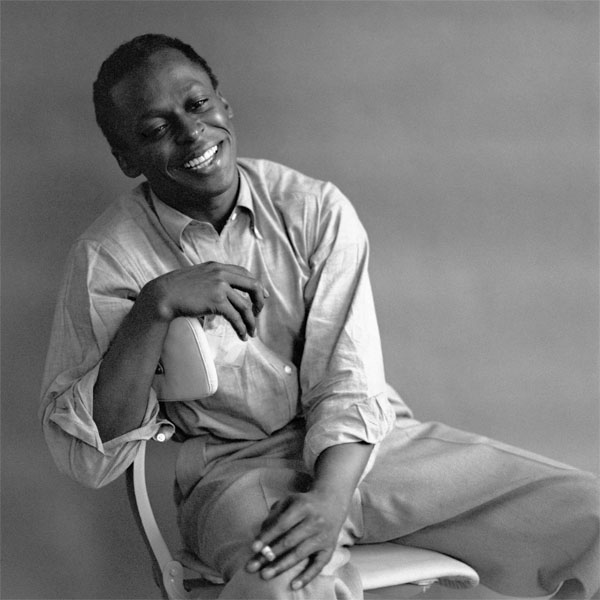
Miles and Coltrane: A Century of Jazz
These two were born in 1926 and worked side by side for a few years before each charting his own possible future for jazz. Coltrane joined Miles' Quintet in 1955. Four years later, they recorded Kind of Blue together, the ultimate jazz best-seller. To Coltrane, who told him before a concert that he was having trouble ending his choruses, Miles answered dryly: "Try taking the saxophone out of your mouth." From then on, they would represent two paths for jazz.
Despite their occasional understanding and their mutual respect, these two musicians, both of whom entered twentieth-century culture, had plenty of points of divergence, beginning with their social origins. Miles grew up in a well-off family in Illinois, Coltrane in a middle-class family in North Carolina. From this they drew two conceptions of their relationship to the mystical, Coltrane having been born into a deeply pious environment (his father was a reverend) and Miles into a more emancipated milieu (his father was a dental surgeon). That is why the latter graduated from the prestigious Juilliard School, "New Star of the Jazz Trumpet" according to Esquire at barely twenty, and an icon of Saint-Germain-des-Prés, while Coltrane, after a stint in the Marines big band, played rhythm 'n' blues and held chairs in major orchestras.
And when they parted ways, Miles formed a second quintet (Wayne Shorter, Herbie Hancock...) which carried him toward an eclectic jazz, while Coltrane revolutionized the quartet formula (McCoy Tyner, Elvin Jones...) and reached acoustic summits, witnessed by the masterpiece A Love Supreme. From then on, he would follow his wife Alice toward Eastern spiritualities, breaking free from the canons of mainstream historical jazz, just as Miles turned toward rock, soul, and funk, guided by his new wife Betty, who plugged him in to Jimi Hendrix and his peers. They would meet again in the beyond, each having an asteroid named after them.
Miles, An Alternative University
In the mid-1960s, the trumpeter had assembled a team, reconstituting in a new way the famous quintet that had made his name during the previous decade. On drums, Tony Williams, fire on the skins; on double bass, Ron Carter, a metronome of the unstinting kind; on piano, Herbie Hancock, already considered a benchmark master of the keyboards; and then the saxophonist Wayne Shorter, the latest arrival, who would breathe in the new direction to follow. "I knew they would form a musical entity," Miles sums up in his autobiography, before going on to detail the qualities of each of those young men destined for the posterity we now know.
It wasn't the first time he had revealed to the world's ears talents bound to become legendary. Coltrane had been brought to light within his band, as had Bill Evans, who would take definitive flight by shedding the weight of Miles' aura. Nor would it be the last time the trumpeter served as a career accelerator (already under way, to be sure) for musicians who benefited from his guidance. Such was the case of John McLaughlin, who landed in New York in early 1969 to join Tony Williams' Lifetime. "By luck, by chance, by fate, I met Miles the very day I arrived. The next day, he invited me to come play on In A Silent Way, a tune by Joe Zawinul. No one knew I was coming!" the guitarist recalled in 2012, before adding: "Miles told me in a zen voice: 'You play like you don't know how to play guitar.” He took the lesson to heart.
"Miles had the intelligence to bring together the best musicians at the best moment, to leave them free to create while pushing them to give their best. I remember him humming the basic rhythms into the ears of the drummers and bassists, just indications, while insisting that we be free." At the time, other future aces were there: Jack DeJohnette, Keith Jarrett, Chick Corea... All know what they owe to Miles, the sorcerer-alchemist. Soon others would join this informal university: John Scofield, Kenny Garrett, and of course Marcus Miller, the gifted bassist who would produce albums for his boss. "Miles made me discover my own voice as a bassist. (...) In Miles' band, I couldn't copy anyone and have the right sound. He forced me to play what I felt."
Miles the Eclectic
Rarely has a musician been able to put his gains back on the line, having "revolutionized music five times," in his own words. He was always on the lookout, quick to change at the prompting of his intuitions. As he stepped onto the scene, Miles chose the path of Charlie Parker's bebop. "I was in such shock I couldn't read a single note." More than the classy Juilliard School, it was in the clubs of 52nd Street that he took good notes from his mentors, among them Max Roach. "He taught me everything when we were living together and playing with Charlie Parker. He taught me that the drummer must always protect the rhythm with an inner pulse, and for that you need faith, a rhythm within the rhythm."
At the cutting edge of the jazz avant-garde, the newly anointed one would already be reborn with Birth of the Cool, the founding act of a friendship built to last with Gil Evans, who chose to slow the tempo. The West Coast style would soon take its cue from it, and Miles would keep from it a sense of silence that would also set his style apart. No time to catch his breath before he creates a new formula with Walkin': "I wanted to bring the music back toward fire, toward the improvisations of bebop." On its heels, a first quintet that would leave its mark. Hard bop reconnects with the expressive power of the negro spirituals. He could have stopped there and would already have entered the legend of jazz. Except that the trumpeter looks ahead: he has just recorded Miles Ahead, and he is about to cut Milestones, the manifesto of modal jazz. Gil Evans then offers him settings, like the indispensable Sketches Of Spain in 1960.
Four years later, here he is again at the head of a second quintet whose ambition is controlled freedom in the age of free jazz. E.S.P., Miles Smiles, Sorcerer... Constantly on the alert, the group rests on a near-telepathy of music. At the peak, Miles sets off a new aesthetic upheaval, shaken by Sly Stone and Jimi Hendrix. The recordings become sessions of collective improvisation, recomposed in post-production by Teo Macero. In a couple of years, he strings together sessions that make history: In A Silent Way, Bitches Brew, Live-Evil... The electric Miles pushes the pitch all the way, in a free afro-funk furia that prefigures what the sound of a jazz on technological life-support would become.
In the meantime, after the formidable oration He Loved Him Madly for Ellington, and then a retreat during which he no longer touched his instrument, the Phoenix everyone thought had burned out from getting too close to artificial paradises is reborn in 1980. No more sweet ravings: Miles converts to a more readable music that lets him win over a renewed audience. As foretold in the explicit We Want Miles, he has become a star. Tutu would be the ultimate peak, before he tried his hand at hip-hop with the rapper Easy Mo Bee. Weary, for the first time in his life, in 1991 he conceded to concerts revisiting his past. The verdict was in.
Miles, Iconic
Star People. The very title of this 1983 album is a reminder that Miles crossed the eras while staying hip. And that began as early as Parker's death, when Marlon Brando, Frank Sinatra, Ava Gardner came to listen to the prodigy. A few years earlier, he had had an affair with Juliette Gréco, the muse of Saint-Germain-des-Prés. In the spring of 1949, they loved each other for a handful of weeks, and then a whole life by proxy. "I had never seen a man so handsome, and I haven't since," Juliette Gréco would recall much later. "I was in the wings and he was playing: the profile of an Egyptian god!" the singer said. And he: "Music had been my whole life until I met Juliette. She taught me what it was to love someone other than music."
The Frenchwoman would not be the only one. Among all his conquests, Betty Mabry, a young soul singer with a feisty temperament, would restyle the former man in the green shirt. Oversized glasses, lizard-skin pants, leather bracelets... The hour was for psychedelic hues, and the trumpeter then frequented a Soho boutique run by two friends, Colette and Stella, the wife of Alan Douglas, Hendrix's manager. "In that clothing shop, everyone was there: Ornette, Larry Young, the Rolling Stones, and Miles." Miles' dressing room, as vast as a living room, housed hundreds of stage outfits, lined up behind an elegant curtain opened by an electric mechanism. The painter Mati Klarwein also haunted the place. The cover of Bitches Brew was born from that close encounter of the third kind.
About fifteen years later, still styled from head to toe, the "Picasso of jazz" would meet another woman: the sculptor Jo Gelbard, whom he crossed paths with in the elevator. They lived in the same Fifth Avenue building. Love at first sight and unprecedented consequences. "He was making sketches and asked me to help him. So I went up to his apartment, looked at his works, and gave him my opinion," she recalled in 2005 during an interview with JazzWise. Miles would paint in a style close to Basquiat's, with an Afro touch. "When he picked up his brush and his paint, he was formidable, like a child with tubes of paint in kindergarten. He would pour generously and mix until he got a paste that was too thick, then he would cover everything. He loved the texture and the feel." Nothing to do with the image that adorns the soundtrack he signed in tribute to the boxer Jack Johnson. There we see the first Black heavyweight world champion at the wheel of a gleaming convertible, white women at his side. The parallel with Miles seems obvious: he who liked to break the codes of good conduct, who loved beautiful cars (at the risk of breaking his own body), who put on the boxing gloves, having had as his first model Sugar Ray Robinson, another world champion known for his flamboyant style. The whole thing is a symbol.
Miles, the Reference Pianists
"I think a lot about Monk these days, because everything he composed can be found without any problem in the new rhythms young musicians use today..." In the winter of his life, the trumpeter takes stock, and on the list of those who mattered are a fair number of pianists. Starting with Duke Ellington, whose offer to join the orchestra he turned down but to whom he would no doubt pay the most vibrant tribute at the time of his death, in 1974. Twenty years earlier, there was Monk, with whom he had quite a bit to handle during sessions that became legendary. On a take of The Man I Love, you can hear them arguing, Miles telling the legendary sound engineer Rudy Van Gelder to keep everything on tape. On that tune, Monk holds back in an eloquent silence, a moment of suspension that today rings out as a great moment of music, just like his solo on Bag's Groove, where he sculpts in blocks the sound of the future facing the visionary sound-prober that Miles was.
During the 1950s, there would be a plethora of masters of the black and white keys: Horace Silver, Red Garland, and the like. There would above all be Ahmad Jamal, whom he went to hear on his sister's advice. "All my inspiration comes from him," he would say as early as 1958. They would leave no recorded trace together, even though Miles salutes the Pittsburgh pianist with Ahmad Blues. That same year, Bill Evans joined Miles' band for a little under a year. Not much, but enough to engrave a summit: Kind of Blue. "His way of playing, the sound he got, evoked crystalline notes or the sparkling water of a clear waterfall. I had to adapt the band's sound to Bill's style by playing different pieces, softer at the start." And as the 1960s open, Miles recruits a young prodigy: Herbie Hancock, who would lay his touch on the decade, to the point of being encouraged by the boss to play a Fender Rhodes as early as 1968, and then even a Farfisa.
"The acoustic piano is an outdated instrument. It belongs to Beethoven and no longer fits our era." We know what came next for Herbie Hancock, who would resolutely plug into that electric current. For Miles, there would be a few more aesthetes of the keyboard: Joe Zawinul on organ, Chick Corea on electric piano, Keith Jarrett also at the stool. In reaction to the heretical visions of the sound sorcerer, they would all soon produce founding records. Without forgetting to mention the one who was his "best friend," Gil Evans, who would tailor arrangements to fit the man for whom music was also a matter of silence.
By Jacques Denis